Saturday, January 27, 2018

TU B’SHVAT - THE NEW YEAR OF TREES

Excerpt from the book "Remember, Observe, Rejoice" © Petra van der Zande


"As others have planted for you, so you will plant for your children."
Leviticus Rabbah, 28

Tu B’shvat, the 15th of the Hebrew month of Shvat (end of January, beginning of February) is not mentioned in the Bible. However, the Mishnah (part of the Talmud), describes it as the "New Year for trees". Israel’s rainy season is usually over by now, but people still hope for the blessing of the "latter rain". This holiday marks the revival of nature, which is symbolized by the budding of the almond tree.

Leviticus 19 tells us what was expected from the Israelites when they entered the Promised Land:
“When you come to the land and you plant a tree, you shall treat its fruit as forbidden; for 3 years it will be forbidden and not eaten. In the fourth year, all of its fruit shall be sanctified to praise the Lord. In the 5th year you may eat its fruit.” (NIV)

Having a specific date as the New Year for trees also helped with the law of tithing – 1/10th of the farmer’s fruit had to be donated to the priests.

Biblical tithes were: 
  •        Orlah - refers to a biblical prohibition (Leviticus 19:23) on eating the fruit of trees produced during the first three years after they are planted.
  •        Neta Reva'i - refers to the biblical commandment (Leviticus 19:24) to bring fourth-year fruit crops to Jerusalem as a tithe.
  •           Ma'aser Sheni - was a tithe which was eaten in Jerusalem.
  •         Ma'aser Ani - was a tithe given to the poor (Deuteronomy 14:22-29) that were also calculated by whether the fruit ripened before or after Tu B'shvat.

 During the Second Temple period it was customary to plant a tree when a child was born - a cedar for a boy (referring to its height and strength), and a cypress (smaller and fragrant) for a girl. When the child married, the wood of the tree was used to make the chuppah, the wedding canopy.

Throughout the ages, the diverse Jewish communities in the Diaspora developed all kinds of customs to celebrate this day. In the beginning of the 19th century, when the first Jewish settlers began to redeem Eretz Israel, part of their work was to plant trees on the barren and eroded hills.

On Tu B'shvat, January 25, 1890, Rabbi Zeev Yavetz and his students set a good example by planting trees in the agricultural colony of Zichron Ya’akov.

The idea to plant trees on Tu B'shvat, was in 1908 adopted by the Jewish Teachers Union and later by the Jewish National Fund (Keren haKayemet leIsrael), who, amongst other endeavours, began to oversee the forestation of the Land of Israel.

Many of Israel’s major institutions have chosen this day for their inauguration ceremonies.
The cornerstone of the Hebrew University of Jerusalem was placed on Tu B'shvat 1918, and the first stone of Haifa’s Technion was laid on the same day in 1925. The first Jewish parliament of the Jewish sovereign State chose to hold its first Knesset session on Tu B'shvat 1949.

On Tu b’Shvat it is customary to eat the types of dried fruit mentioned in Deuteronomy 8:8 (the Seven Species). Some Orthodox Jews make candy from their Etrog (one of “Four Species” during Sukkot) and eat it during Tu B'Shvat.

Tu B'shvat is sometimes called the Jewish Arbour day. 

The highlight of the holiday is planting a new sapling in the soil of Eretz Israel, the Jewish homeland. 


Friday, October 20, 2017

Introduction to the Gospel of Luke - Part 1

Sermon by Pastor Joel McElreath  preached at JBC on August 6, 2017 

This sermon outline is linked to the audio file:

Scripture Reference: Luke 1:1-4; 2:41 -3:1-20
                                          
INTRODUCTION: Each of the four gospels is uniquely different from the others.  From Revelation 4:7, historically, these four symbolize the 4 gospels.  Matthew is the regal lion. Mark is the ox representing Jesus’ work. Luke is the face of a man representing Jesus’ humanity. John is the eagle representing Jesus’ divinity from above. We begin today in our study of the Gospel of Luke.

 I.  THE AUTHOR AND STYLE OF THE GOSPEL  1:1-4

Luke 1: 1-4  ASB
Inasmuch as many have undertaken to compile an account of the things accomplished among us, 2 just as they were handed down to us by those who from the beginning were eyewitnesses and servants of the word, 3 it seemed fitting for me as well, having investigated everything carefully from the beginning, to write it out for you in consecutive order, most excellent Theophilus; 4 so that you may know the exact truth about the things you have been taught.    

A.   The author. A physician from Antioch where the first church was planted.  He was a Greek of high education.
       B.     The style of writing.  This gospel is the most literary book in the New Testament.  The Prologue is written in Classical Greek.
       C.      The historical accuracy.  The writer Luke is a historian of the first rank and listed among the best in the ancient world.
       D.     The aim of the gospel was to demonstrate especially to Gentile believers the historical facts upon which their faith was based.

II.  THE EARLY LIFE OF JESUS.  2:41-52

Luke 2:41 Now His parents went to Jerusalem every year at the Feast of the Passover.

A.  Only Luke records the early years of Christ’s life.  Curiosity of later generations resulted in fabricated stoies like in the Apocrypha writings.
B.  The Eternal Son visits His Father’s house in Jerusalem.  The eternal and unique relationship that Jesus had with His Father begins to be revealed.                                                                                                                                 

III.  THE MINISTRY OF JOHN THE BAPTIST.  3:1-20

Luke 3:1-20

Now in the fifteenth year of the reign of Tiberius Caesar, when Pontius Pilate was governor of Judea, and Herod was tetrarch of Galilee, and his brother Philip was tetrarch of the region of Ituraea and Trachonitis, and Lysanias was tetrarch of Abilene, 2 in the high priesthood of Annas and Caiaphas, the word of God came to John, the son of Zacharias, in the wilderness. 3 And he came into all the district around the Jordan, preaching a baptism of repentance for the forgiveness of sins; 4 as it is written in the book of the words of Isaiah the prophet, “The voice of one crying in the wilderness, ‘Make ready the way of the Lord, Make His paths straight.5 ‘Every ravine will be filled, And every mountain and hill will be brought low; The crooked will become straight, And the rough roads smooth; 6 And all flesh will see the salvation of God.’” 7 So he began saying to the crowds who were going out to be baptized by him, “You brood of vipers, who warned you to flee from the wrath to come? 8 Therefore bear fruits in keeping with repentance, and do not begin to say to yourselves, ‘We have Abraham for our father,’ for I say to you that from these stones God is able to raise up children to Abraham. 9 Indeed the axe is already laid at the root of the trees; so every tree that does not bear good fruit is cut down and thrown into the fire.”10 And the crowds were questioning him, saying, “Then what shall we do?” 11 And he would answer and say to them, “The man who has two tunics is to share with him who has none; and he who has food is to do likewise.” 12 And some tax collectors also came to be baptized, and they said to him, “Teacher, what shall we do?” 13 And he said to them, “Collect no more than what you have been ordered to.” 14 Some soldiers were questioning him, saying, “And what about us, what shall we do?” And he said to them, “Do not take money from anyone by force, or accuse anyone falsely, and be content with your wages.” 15 Now while the people were in a state of expectation and all were wondering in their hearts about John, as to whether he was the Christ, 16 John answered and said to them all, “As for me, I baptize you with water; but One is coming who is mightier than I, and I am not fit to untie the thong of His sandals; He will baptize you with the Holy Spirit and fire. 17 His winnowing fork is in His hand to thoroughly clear His threshing floor, and to gather the wheat into His barn; but He will burn up the chaff with unquenchable fire.” 18 So with many other exhortations he preached the gospel to the people. 19 But when Herod the tetrarch was reprimanded by him because of Herodias, his brother’s wife, and because of all the wicked things which Herod had done, 20 Herod also added this to them all: he locked John up in prison.

A.  The precise dating of the ministry is established by listing contemporary leaders and is probably set at 26-27 A.D.  John fulfilled Isaiah’s prophecy in 40:3-5.

B.   The five descriptions of John’s ministry:
       1.  The road builder – 3:1-6.  John was both a prophet and the subject of prophecy
       2.  The farmer – 3:7-9.  John is chopping down fruitless trees and watching snakes fleeing burning fields.
       3.  The counselor – 3:10-14.  John took personal time to counsel people and prepare them for baptism and their new faith.
       4.  The witness – 3:15-18, 21-23.  John did not come to talk about himself but to bear witness and point to the “Lamb of God.”
       5.   The martyr – 3:19-20.  Luke does not give the full account of John’s arrest and martyrdom, but Matthew and Mark do.  (Matt. 14:1-12; Mk. 6:14-29).

APPLICATION:
1.  The Gospel of Luke is a Book of unique facts that complement the other three gospels.  It gives us doctrines for our faith and ethics to guide our actions.   The theme of joy sings its way through this book as Paul’s letter to the Philippians.
2.   John the Baptist’s life is a wonderful example for us in both attitude and action.  He was truly great in God’s sight because he was truly small in his own sight. 
3.   John was an effective preacher because it is written, “The word of the Lord came to ..John.”  
He proclaimed God’s message, denounced sin and hypocrisy and stressed repentance and faith.

John preaches, ‘Repent, for the Kingdom of heaven has come near.’

Saturday, August 12, 2017

Behind the Hymn: Day by Day

Carolina Sandell Berg: Songs out of Tragedy  - DAY BY DAY

Psalm 46 declares, "God is my refuge, an ever present help in time of trouble." 
There was once a young Swedish woman who, like the Psalmist, learned early in life to trust in the Lord's strength each day to help her overcome her troubles and trials. 
Her name was Carolina Sandell Berg. 

Born October 3, l832, she grew up to become Sweden's most celebrated author of Gospel hymns, and wrote so many that she is often called "the Fanny Crosby of Sweden."*
Like many Christians, Carolina learned that when pain and tragedy strike, God may use that experience to deepen our faith. 

When she was 26, Carolina -or Lina (pronounced Lie-nah) as she liked to be called- experienced a tragedy which profoundly affected the course of her life. She was with her father, a Lutheran pastor, crossing a Swedish lake. Suddenly the ship lurched, and before her eyes, her father was thrown overboard and drowned. 

Lina had written hymns before, but now she poured out her broken heart in an endless stream of beautiful songs. Her hymns mightily influenced the revival that swept across Scandanavia after l850.

The words of Lina Berg's hymns were all the more popular because of the simple, beautiful melodies written for them, especially those of Oscar Ahnfelt who played his guitar and sang her hymns throughout Scandanavia. Lina Berg once said that Ahnfeld sang her songs "into the hearts of the people." Even Jenny Lind, the world-famous concert vocalist, visited factories and sang Lina's beautiful hymns. 

In Matthew l2:34, Jesus said: "Out of the abundance of the heart, the mouth speaketh." Lina Sandell Berg's voice spoke more than 650 hymns from a heart filled abundantly with love for her Saviour. 
In one of them, "Day by Day," she had this to say:

"Day by day and with each passing moment,
Strength I find to meet my trials here;
Trusting in my Father's wise bestowment,
I've no cause for worry or for fear."


-----------
* Fanny Crosby was a blind American hymnwriter who wrote the equivalent of seventeen books of hymns.

Bibliography:
1. Adapted from an earlier Christian History Institute story by Diana Severance, Ph. D.
2. "Karolina Wilhelmina Sandell-Berg." http://www.cyberhymnal.org

Saturday, August 5, 2017

Tu B'Av - the Jewish Valentine's Day

Tu B'Av (the fifteenth of the month Av) is a minor Jewish holiday. 

Historical significance
According to the Mishna, Tu B'Av was a joyous holiday in the days of the Temple in Jerusalem, marking the beginning of the grape harvest. Yom Kippur marked the end of the grape harvest. On both dates, the unmarried girls of Jerusalem dressed in white garments, and went out to dance in the vineyards (Babylonian Talmud, tractate Ta'anit 30b-31a). That same section in the Talmud states that there were no holy days as happy for the Jews as Tu B'Av and Yom Kippur. The holiday celebrated the wood-offering brought in the Temple (see Nehemiah 13:31). Josephus refers to it as the Feast of Xylophory ("Wood-bearing").
  • Various reasons for celebrating on Tu B'Av are cited by the Talmud and Talmudic commentators:     While the Jews wandered in the desert for forty years, female orphans without brothers could only marry within their tribe, to prevent their father's inherited land in the Land of Israel from passing on to other tribes. On the fifteenth of Av of the fortieth year, this ban was lifted. (See Daughters of Zelophehad.)
  • That same year, the last of the generation of the sin of the spies, which had been forbidden to enter the Promised Land, found that they were not destined to die. For forty years, every Tisha B'av night, the Jews made graves for themselves in which they slept on Tisha B'Av; every year a proportion of them died. In the 40th year, the fifteen thousand who had remained from the first generation went to sleep in the graves and woke up the next day to their surprise. Thinking they made a mistake with the date, they did this until they reached Tu B'Av and saw a full moon. Only then did they know they were allowed to live.
  • The Tribe of Benjamin was allowed to intermarry with the other tribes after the incident of the Concubine of Gibeah (see Judges chapters 19–21).
  • Cutting of the wood for the main altar in the Temple was completed for the year.
  • King Hoshea of the northern kingdom removed the sentries on the road leading to Jerusalem, allowing the ten tribes to once again have access to the Temple.
  • The nights, traditionally the ideal time for Torah study, are lengthened again after the summer solstice, permitting more study.
  • The Roman occupiers permitted burial of the victims of the massacre at Bethar during the Bar Kochba rebellion. Miraculously, the bodies had not decomposed, despite exposure to the elements for over a year.


Modern times
Tu B'Av marks an informal "high" to counter the "low" of The Three Weeks leading up to Tisha B'Av. It has become a romantic Jewish holiday, often compared to Valentine's Day, and has been said to be
a "great day for weddings, commitment ceremonies, renewal of vows, or proposing". Also, "It is a day for romance, explored through singing, dancing, giving flowers, and studying."
source: Wikipedia

Introduction to the Gospel of Luke

             
Sermon: Introduction to the Gospel of Luke 
Luke 1:1-4; 2:41 -3:1-20.  
By Pastor Joel McElreath

INTRODUCTION: Each of the four gospels is uniquely different from the others.  From Revelation 4:7, historically, these four symbolize the 4 gospels. 


Matthew is the regal lion. Mark is the ox representing Jesus’ work. Luke is the face of a man representing Jesus’ humanity. John is the eagle representing Jesus’ divinity from above. We begin today in our study of the Gospel of Luke.


I.  THE AUTHOR AND STYLE OF THE GOSPEL  1:1-4.

A.     The author. A physician from Antioch where the first church was planted.  He was a Greek of high education.
B.     The style of writing.  This gospel is the most literary book in the New Testament.  The Prologue is written in Classical Greek.
C.      The historical accuracy.  The writer Luke is a historian of the first rank and listed among the best in the ancient world.
D.     The aim of the gospel was to demonstrate especially to Gentile believers the historical facts upon which their faith was based.

II.  THE EARLY LIFE OF JESUS.  2:41-52

A.  Only Luke records the early years of Christ’s life.  Curiosity of later generations resulted in fabricated stoies like in the Apocrypha writings.

B.  The Eternal Son visits His Father’s house in Jerusalem.  The eternal and unique relationship that Jesus had with His Father begins to be revealed.                                                                                                   
                                              

III.  THE MINISTRY OF JOHN THE BAPTIST.  3:1-20.

       A.  The precise dating of the ministry is established by listing contemporary leaders and is probably set at
26-27 A.D.  John fulfilled Isaiah’s prophecy in 40:3-5.

       B.   The five descriptions of John’s ministry:

       1.  The road builder – 3:1-6.  John was both a prophet and the subject of prophecy
       2.  The farmer – 3:7-9.  John is chopping down fruitless trees and watching snakes fleeing burning fields.
       3.  The counselor – 3:10-14.  John took personal time to counsel people and prepare them for baptism and their new faith.
       4.  The witness – 3:15-18, 21-23.  John did not come to talk about himself but to bear witness and point to the “Lamb of God.”
       5.   The martyr – 3:19-20.  Luke does not give the full account of John’s arrest and martyrdom, but Matthew and Mark do.  (Matt. 14:1-12; Mk. 6:14-29).

APPLICATION:
1.  The Gospel of Luke is a Book of unique facts that complement the other three gospels.  It gives us doctrines for our faith and ethics to guide our actions.   The theme of joy sings its way through this book as Paul’s letter to the Philippians.
2.   John the Baptist’s life is a wonderful example for us in both attitude and action.  He was truly great in God’s sight because he was truly small in his own sight. 
3.   John was an effective preacher because it is written, “The word of the Lord came to ..John.” 
He proclaimed God’s message, denounced sin and hypocrisy and stressed repentance and faith.


This sermon was preached at Jerusalem Baptist Church, Jerusalem, on August 6, 2017

The audio file will be published on the JBC website: www.jerusalembaptistchurch.com 


Friday, July 28, 2017

Tisha b'Av - the Ninth of Av


© Petra van der Zande              

Excerpt from the book “Remember Observe Rejoice” 

The 9th day of Av usually falls in the middle of the summer holiday, in August.
On this solemn day, the Jewish people commemorate the destructions of their Temples by fasting 24 hours and praying. In Israel, most restaurants and places of entertainment are closed on this day.

Throughout the ages, Tisha b’Av has been a black day in Jewish history.
The Mishnah mentions specific events which took place:
  •         On this day, the twelve spies returned to Moses; ten of them with bad news about the Promised Land.
  •         In 586 BC, Nebuchadnezzar destroyed Solomon’s Temple and sent the Judeans into Babylonian Exile.
  •        In 70 AD, the Second Temple was destroyed by the Romans, and the people in Judea scattered. It heralded the beginning of the Jewish exile from Eretz Israel.
  •        135 AD, Bar Kochba’s revolt against the Romans was crushed and Betar destroyed.

In later years, more Tisha b’Av disasters were added to the list of commemorations. On this day:
  •        All Jews were expelled from England in 1290
  •        The Jews from Spain were expelled in 1492.
  •     The same fate awaited the Jews from Vienna, whose turn came in 1670.
  •        World War I officially began on the 9th of Av in 1914, when Germany declared war on Russia.

In the period between the 17th of Tammuz (July) till the 9th of Av, (August), religious Jews don’t eat meat, drink no wine (except for Shabbat), do not wear new clothes, and do not schedule happy events, such as weddings and house dedications. The 25 hour fast begins at nightfall on the 9th of Av.

In the synagogue, the Ark housing the Torah scrolls is draped in black and the lights are dimmed.  Wearing only socks or slippers, no (leather) shoes, people sit on the floor or on low stools. Like true mourners, they don’t greet each other with “Shalom”. 
Torah study is forbidden, for this is considered to be a joyful activity. During this fast day, the book of Lamentations, Job and parts of Jeremiah are read in the synagogue.
Special mourning prayers, kinot (written during the Middle Ages) are also recited.

Orthodox Jews believe that when Messiah comes, Tisha b’Av will be a day of celebration instead of mourning.

"Thus says the LORD of hosts: 'The fast of the fourth month, The fast of the fifth, The fast of the seventh, And the fast of the tenth, Shall be joy and gladness and cheerful feasts for the house of Judah. Therefore love truth and peace." Zechariah 8:19 (NKJV)

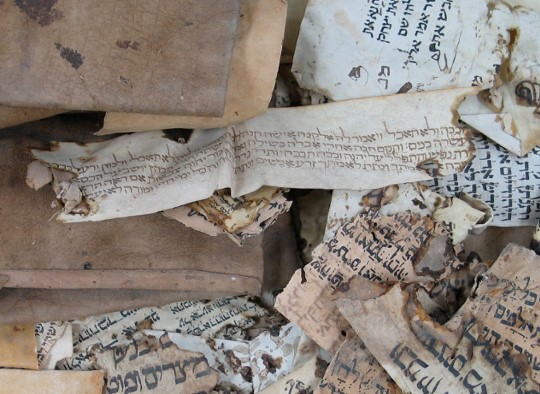
A religious Jew will never throw away his old prayer book, or discard a Torah Scroll. These are kept in a special place (Genizah*) and are usually buried on Tisha b’Av.


Fragments like these, considered too holy to be discarded as trash, are stored in the genizah.


Friday, July 14, 2017

Behind the Hymns - The God of Abraham's Praise

From The Yigdal of Daniel ben Judah, a Jewish judge in Rome, circa 1400, paraphrased by Thomas Olivers, circa 1765; first appeared in The Gospel Magazine, April 1775. The lyrics are based on the 13 creeds of Moses Maimonides (circa 1130-1204).
Thomas Olivers 1725-1799

One night in London, [Olivers] was attracted to a service in a Jewish synagogue, where he heard a great singer, Leoni, sing an ancient Hebrew melody in the solemn, plaintive mode and he became impressed with a desire to write a hymn to that tune. The result was our hymn, The God of Abraham Praise, which in a sense is a paraphrase of the ancient Hebrew Yigdal, or doxology, though Olivers gave to it a distinctly Christian flavor.

The story is told of a young Jewess who had been baptized into the Christian faith, and in consequence was abandoned by her family. She fled to the home of the minister, poured out her heart to him, and as if to show that, after all, her joy in her new-found Saviour was greater than all her loss of home and family, she sang, "The God of Abraham Praise."


Leoni Hebrew melody, Sacred Harmony, 1780

The God of Abraham praise, who reigns enthroned above;
Ancient of everlasting days, and God of Love;
Jehovah, great I AM! by earth and Heav’n confessed;
I bow and bless the sacred name forever blessed.

The God of Abraham praise, at whose supreme command
From earth I rise—and seek the joys at His right hand;
I all on earth forsake, its wisdom, fame, and power;
And Him my only portion make, my shield and tower.

The God of Abraham praise, whose all sufficient grace
Shall guide me all my happy days, in all my ways.
He calls a worm His friend, He calls Himself my God!
And He shall save me to the end, thro’ Jesus’ blood.

He by Himself has sworn; I on His oath depend,
I shall, on eagle wings upborne, to Heav’n ascend.
I shall behold His face; I shall His power adore,
And sing the wonders of His grace forevermore.

Tho’ nature’s strength decay, and earth and hell withstand,
To Canaan’s bounds I urge my way, at His command.
The watery deep I pass, with Jesus in my view;
And thro’ the howling wilderness my way pursue.

The goodly land I see, with peace and plenty blessed;
A land of sacred liberty, and endless rest.
There milk and honey flow, and oil and wine abound,
And trees of life forever grow with mercy crowned.

There dwells the Lord our king, the Lord our righteousness,
Triumphant o’er the world and sin, the Prince of peace;
On Sion’s sacred height His kingdom still maintains,
And glorious with His saints in light forever reigns.

He keeps His own secure, He guards them by His side,
Arrays in garments, white and pure, His spotless bride:
With streams of sacred bliss, with groves of living joys—
With all the fruits of paradise He still supplies.

Before the great Three-One they all exulting stand;
And tell the wonders He hath done, through all their land:
The listening spheres attend, and swell the growing fame;
And sing, in songs which never end, the wondrous name.

The God who reigns on high the great archangels sing,
And Holy, holy, holy! cry, Almighty King!
Who was, and is, the same, and evermore shall be:
Jehovah—Father—great I AM, we worship Thee!

Before the Savior’s face the ransomed nations bow;
O’erwhelmed at His almighty grace, forever new:
He shows His prints of love—they kindle to a flame!
And sound thro’ all the worlds above the slaughtered Lamb.

The whole triumphant host give thanks to God on high;
Hail, Father, Son, and Holy Ghost, they ever cry.
Hail, Abraham’s God, and mine! (I join the heav’nly lays,)
All might and majesty are Thine, and endless praise.


http://www.hymntime.com/tch/htm/g/o/d/godofabe.htm